A credentialing workflow a surveyor can read.
Built by someone who has sat in front of the surveyor. Practitioner and facility credentialing on a guarded state machine with an immutable audit trail, and automated primary-source verification that expands as each data agreement is signed. Runs on its own, or with the rest of Vernier.
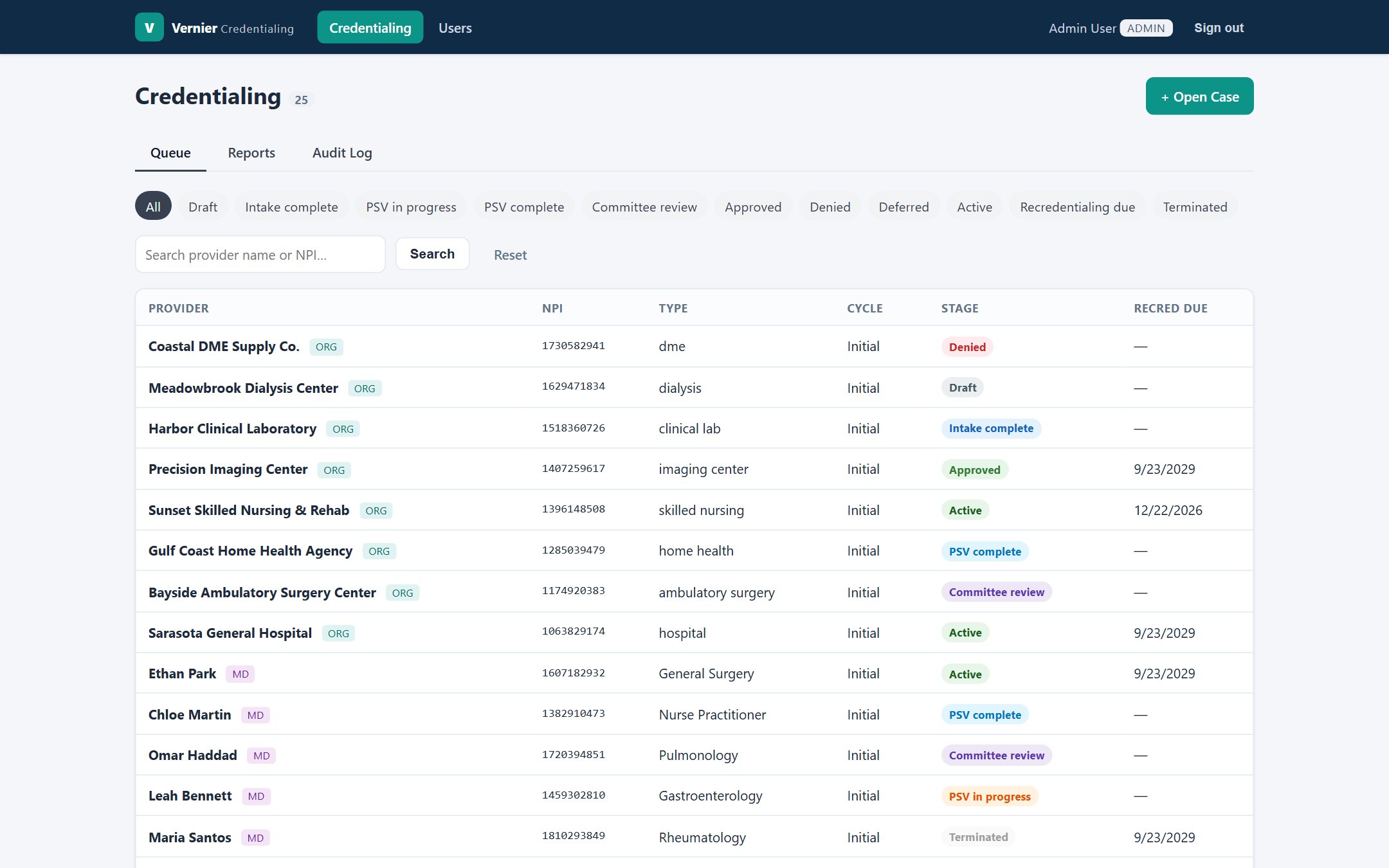
When the auditor asks for the file, the answer today is a binder.
Most small and mid-size payers, PACE organizations, FQHC networks and IPAs run credentialing on spreadsheets, shared drives and a part-time coordinator, and are audited against NCQA and CMS standards as if they were running a system. Vernier turns the binder into a printable credentialing packet with a tamper-evident history behind it.
NCQA workflow state machine
Draft, intake, primary-source verification, committee review, approved or denied or deferred, active, recredentialing. Transitions are guarded: a case cannot reach committee until verification is complete and timely.
Practitioners and organizations
MDs, DOs, NPs, PAs and other practitioners on one element set. Hospitals, labs, imaging, home health, SNFs, ASCs, DME and dialysis facilities on the organizational set. Non-accredited facilities automatically require CMS certification plus a site visit.
Immutable audit trail
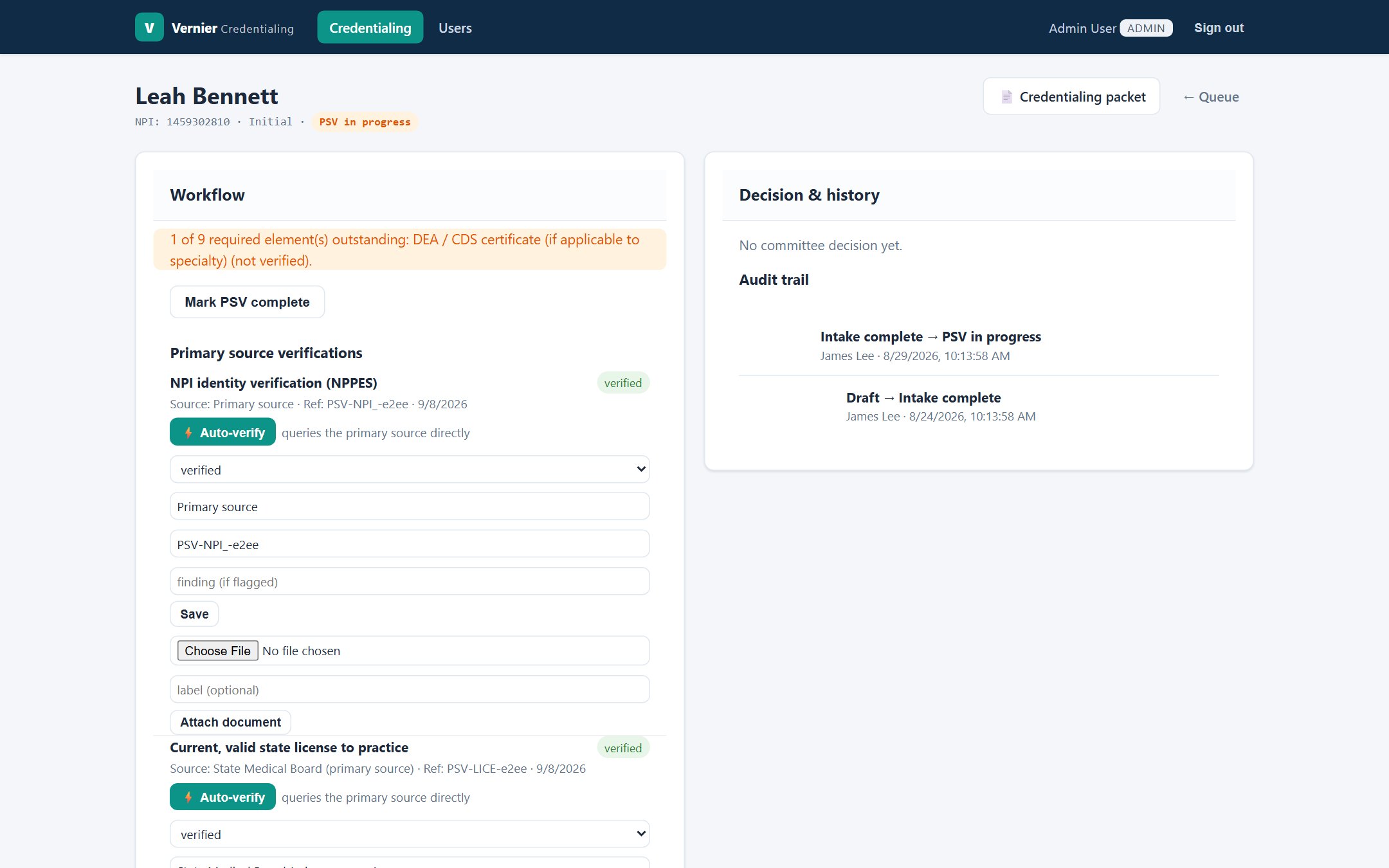
Every transition, verification result, document and decision appends an entry with actor and timestamp. The "dated screenshot" rule from the credentialing protocols, made automatic.
Timeliness built in
The 120-day verification window is enforced before committee. The 36-month recredentialing cycle has a 180-day lead window and a sweep that reopens due cycles and sends reminders.
PSV checklist per element
Status, source, reference, expiry, findings and attached evidence for each NCQA element. License copies, DEA certificates and NPDB reports attach to the verification they support.
Credentialing packet and reports
A print-ready case file with a signature block for committee books and surveyor requests. Pipeline by stage, committee decisions and approval rate, recredentialing-due buckets, expiring credentials, provider roster.
As it stands today, source by source.
When a case enters verification, every adapter-backed element runs automatically. Nothing is requested from the provider; adapters work only from data on the provider record. A sanctions or exclusion match is flagged for the committee and never adjudicated by software. We describe this as an automated PSV architecture, not "no-touch credentialing", because the remaining sources are gated by data agreements rather than by code.
| Source | Status | What it takes to go fully live |
|---|---|---|
| OIG LEIE exclusions | Live | Monthly file auto-downloaded, matched by NPI, name and business name. No gate. |
| NPPES NPI registry | Live | Existence, active status, NPI type, name match. No gate. |
| CMS Medicare opt-out | Live | Queried by NPI inside the sanctions check. No gate. |
| SAM.gov exclusions | Built | Runs once a free SAM.gov API key is set. |
| Florida DOH and AHCA licensing | Built | Download-and-match adapter pointed at the free state extracts; map the columns once. |
| DEA registration | Built | Real checksum validation; sandbox by default pending DEA registrant-file access. |
| NPDB | Built | Runs once NPDB querying-entity registration is complete; per-query fees apply. |
| Board certification, education, training | Built | Runs once the AMA Profiles agreement is executed; ECFMG for international graduates. |
| CAQH ProView application and attestation | Built | Runs once the CAQH Participating Organization agreement is executed. |
Every automated result records source, reference, timestamp and acting user into the case's audit trail. Verification timeliness is enforced by the workflow regardless of how the verification was performed.
Already running on its own for a client who wanted only this.
Credentialing was split out of Vernier for a client that needed NCQA credentialing without the CRM or the portals. It shares no code or database with the other applications, deploys as its own container, and offers a session-authenticated JSON API, including an on-demand recredentialing sweep, so a plan can trigger work from its own scheduler.
The demo boots with a seeded dataset across every workflow stage, with valid NPIs and checksum-valid DEA numbers, so an informatics team can check the data rather than take our word for it.
Show us your binder.
Twenty minutes: one case from intake to committee, the packet it produces and the audit trail behind it.