Eight applications. One data spine. Buy the whole platform or one module.
Vernier is not a dashboard layer. It is eight deployed applications covering the payer, the provider, the member, the agent, credentialing, risk adjustment and the CMS interoperability mandate. Each runs on its own, and all of them share one population.
The inventory, as it stands.
Every application below can be opened in a browser and shown within sixty seconds of a prospect asking. Where something is a roadmap item, this site says so.
| Application | Who uses it | What it does | Automated checks |
|---|---|---|---|
| Analytics Portal | Plan leadership, risk adjustment, Stars, finance, UM | Fourteen modules: findings dashboard, Patient 360, provider directory hygiene, coding suspects, RAPS triage, Star Ratings, MLR, utilization, membership and churn, claims and denials, encounter submission, member materials readiness, provider documents, premium billing. | 41 population properties verified |
| Interoperability (FHIR) | CIO, compliance, UM | The four CMS-0057-F APIs (Patient Access, Provider Access, Payer-to-Payer, Prior Authorization), FHIR Bulk Data export, and the public prior-authorization metrics disclosure. | 42 HTTP conformance assertions |
| Admin Portal | Member services, agent services, clinical, compliance | Fourteen modules: enrollment lifecycle, agents, scope of appointment, HRA and credentialing rosters, authorizations, correspondence, tasks, notifications, workflow, reports, data health, administration. | Role boundaries enforced in middleware |
| Provider Portal | Practice billing, coders, office staff | Eligibility, authorizations, claims worklist, patients, coding, care gaps, directory, remittances, documents. Attribution enforced for every request. | 8 cross-portal consistency checks |
| Member Portal | Members and member services | Coverage and ID card, claims, prescriptions, labs, approvals, appeals, find care, secure messaging, consent center, grounded assistant. | Every list server-paginated and bounded |
| CRM | Outreach and member services staff | Interaction log, tasks, email and physical mail, document upload, six standard reports, admin and agent roles. | — |
| Credentialing | Credentialing coordinators, committee, network | NCQA state machine for practitioners and facilities, PSV checklist, automated primary-source verification, packet, reports, audit log, recredentialing sweep, JSON API. | Immutable audit trail on every move |
| Vernier HRA | Intake agents, nurses, members | Adaptive questionnaire with fourteen condition modules, rules-based assessment engine, nurse review and attestation, versioned living document, command center. | Crisis protocol on suicide screen |
The applications agree with each other.
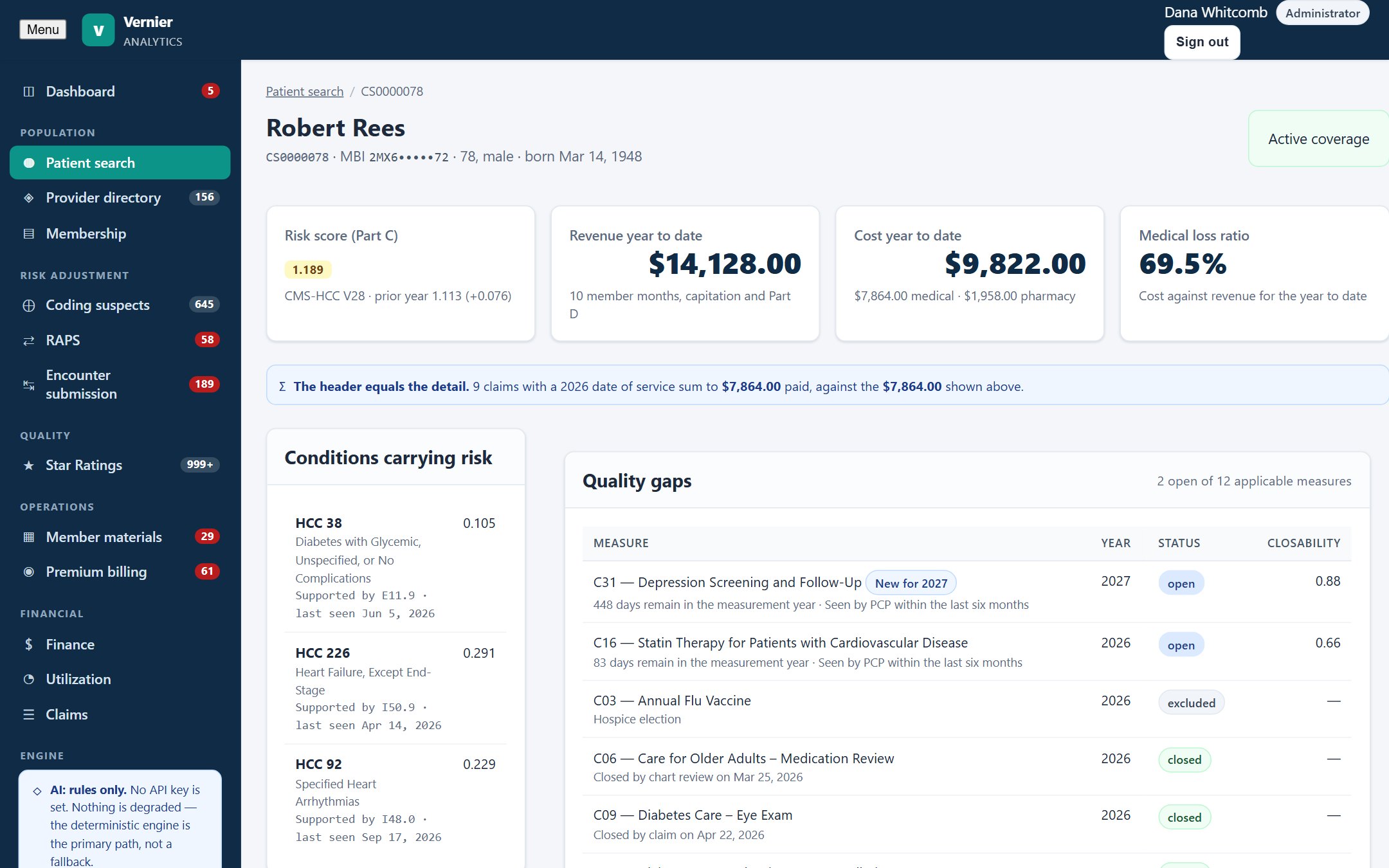
The analytics portal generates a population of 5,000 members, 400 of them with full claim, prescription and lab detail, from a fixed seed. The member portal, provider portal and FHIR service load the same people, with the same IDs, dates of birth, claims and providers.
That is why one member can be traced through four products in a demo and the numbers match at every step. It is also why an informatics team can paste any NPI from the demo into their own validator: every one passes the check digit, and an automated suite keeps it that way.
- Header totals equal the sum of their detail rows, per member.
- Every coding suspect cites a record that exists.
- CMS-HCC V28 displayed, with the V24 number alongside for prior-year reconciliation.
- No RAPS rejection carries a dollar value unless it suppressed a diagnosis.
Read and decide. Your core system keeps the transaction.
What Vernier does
- Ingests your adjudicated claims feed, daily or as often as your feeds arrive.
- Surfaces the exception and the owner: the authorization about to breach the clock, the agent pending past its window, the suspect with evidence, the member materials due.
- Serves the portals your members, providers and staff log into.
- Publishes the FHIR APIs and disclosures CMS-0057-F requires.
- Runs on your infrastructure or ours. Docker image, blueprint, or bare Node.
What Vernier does not do
- Adjudicate or pay claims. That is out of scope, deliberately.
- Generate production 837 files, issue invoices or write into your core administrative system. The transaction executes there.
- Deny a prior authorization. The endpoint accepts and pends with the X12 review action and the determination due date; a qualified person decides.
On the roadmap
- Single sign-on across the portals (separate logins today).
- CSV and Excel export from list views.
- Da Vinci CRD and DTR companions to prior authorization (not required by CMS-0057-F).
Same stack, every application.
Node and Express with server-rendered views, MongoDB, session authentication, role-based access. Each application ships as a Docker image and a deployment blueprint, with a demo mode that boots an embedded database and seeds a complete fictional dataset. Nothing in a demo touches real member data.
Your infrastructure
Deploy the containers into your own environment, behind your own identity and network controls, with your own database.
Hosted by HALOS
A dedicated environment stood up and operated for you, with a Business Associate Agreement in place before any member data moves.
Module by module
Credentialing already runs on its own for a client who wanted it without the rest. Every application can be adopted the same way.
See the eight applications running.
A scheduled walkthrough, not a self-serve link: Bruce opens each application and traces one member across them.