Know in November whether you will report in March.
An ACO now submits clinical quality measures from its participants' EHR data, and the first thing that is scored is whether the data is complete. Vernier matches CMS's eligible list to each practice's records, computes the measures, and shows, practice by practice, which data is missing while there is still time to fix the feed.
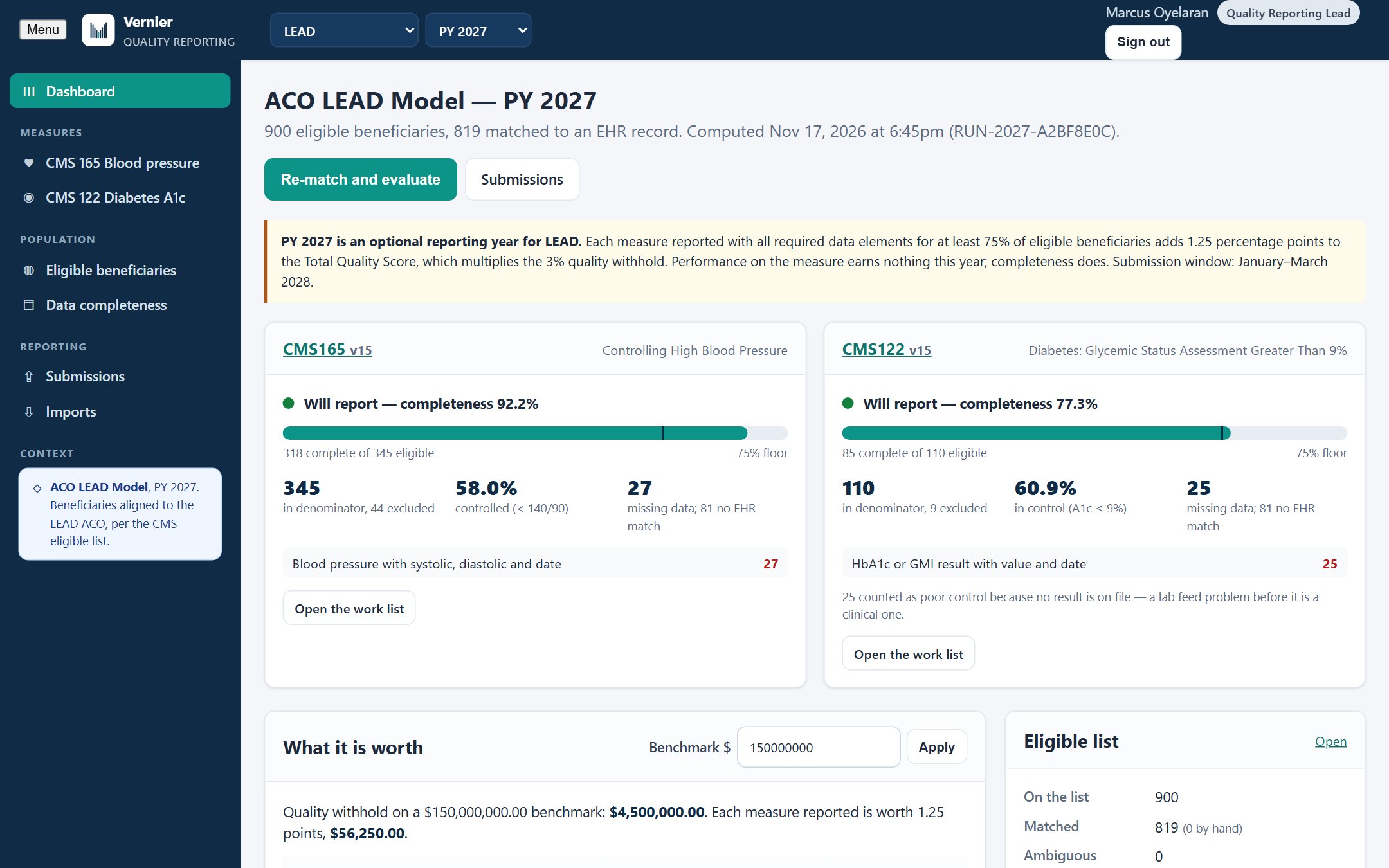
One measure engine, each program's own rules.
The ACO LEAD Model and the MSSP APM Performance Pathway both score Controlling High Blood Pressure (CMS 165) and Diabetes: Glycemic Status Assessment Greater Than 9% (CMS 122), on different populations and with different consequences. The measure logic is shared. What differs is written down per program and per performance year, and a switch in the top bar shows the same people under either.
Matched to the EHR, never guessed
CMS's eligible list is matched to each practice's records by MBI, then by name, birth date and sex. Two candidates is "ambiguous" and waits for a person. A beneficiary with no match is still a row, with every element missing, because CMS will count them.
The 75% floor, by practice and by data element
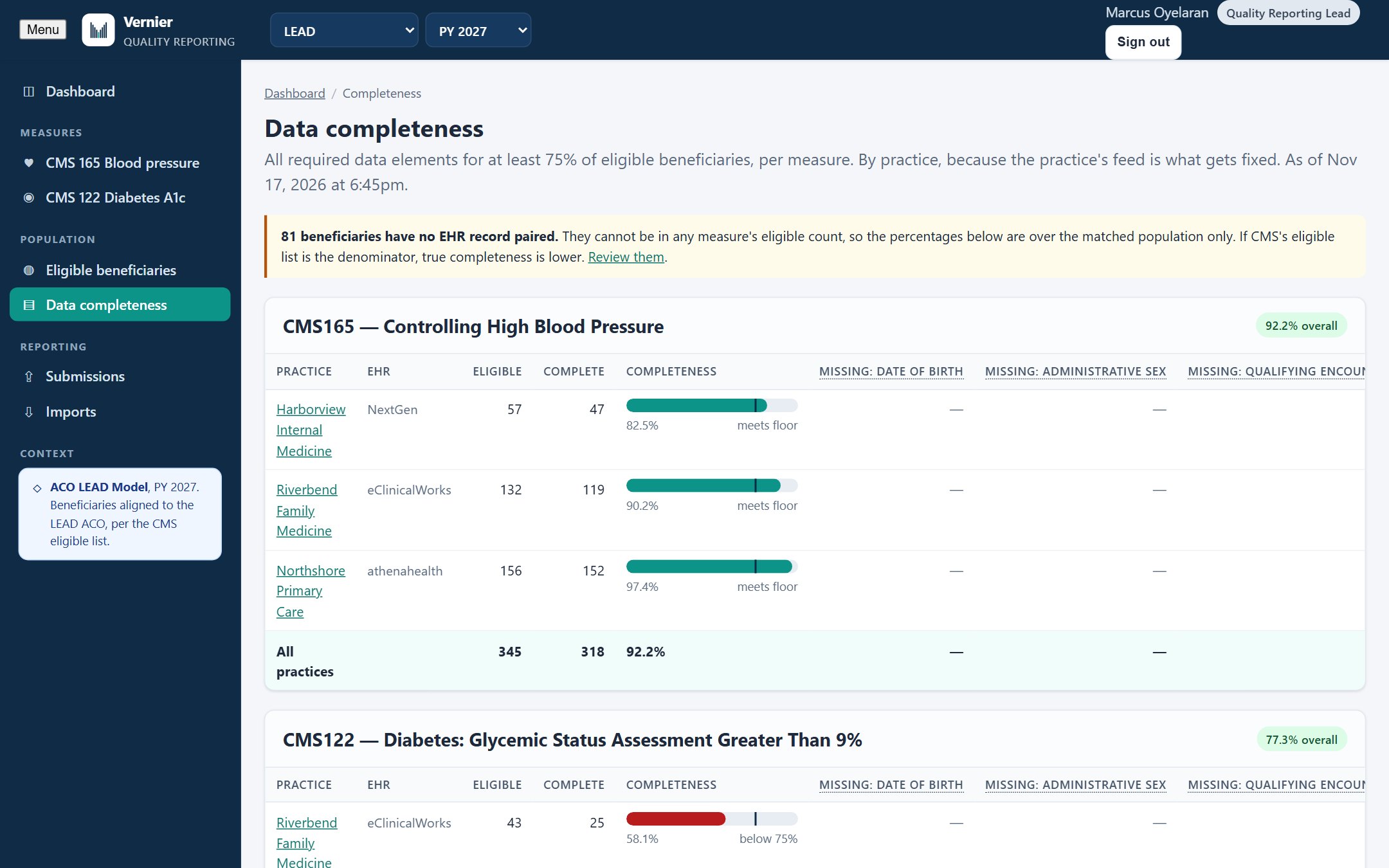
A measure is reported only when the required data is present for at least 75% of eligible beneficiaries. The completeness screen shows which practice and which element is short, so a lab feed that does not flow looks like what it is and not like poor diabetes control.
The rules that change the answer
Readings taken in an acute setting are discarded before the most recent is chosen. Same-day readings take the lowest systolic and the lowest diastolic. A diabetic with no result on file counts as poor control. Each clause has a hand-built test case behind it.
Six views, one evaluation.
- Dashboard: completeness against the floor for each measure, and what reporting each one is worth under the program's rule for that year.
- Measure work lists: beneficiaries by status, with the data element each one is missing.
- Eligible beneficiaries: the CMS list with its match to an EHR record, and the unmatched and ambiguous ones to resolve.
- Data completeness: the floor by practice and by element.
- Submissions: a beneficiary-level workbook built from the evaluation, with its validation.
- Imports: the CMS list and a practice's EHR extract, loaded as CSV with rejected rows explained.
What is built, and what is waiting on CMS.
Sixty-two automated checks
Eighteen hand-built beneficiaries that each test one clause of CMS 165 or CMS 122, the matcher's tie-breaking, the importers, the completeness report, the dollar projection, the workbook and the permission gates.
No generative AI in the measure
A measure result is computed by rules from the record. Nothing here is drafted or suggested by a model.
Not yet
- CMS's official LEAD workbook template, which CMS has not yet published. Today's workbook is a working layout at the same beneficiary-level grain.
- The full value-set expansions for the performance year. The shipped code lists are representative.
- The FHIR submission bundle and QRDA III.
- The three further APP Plus measures, and the claims-based measures CMS calculates.
- The MSSP rules shown are from the CY 2027 proposed rule until the final rule publishes.