Check every month's CMS payment, member by member.
CMS pays a plan for each member each month, then goes on correcting those payments for months afterwards. Vernier reads the files CMS sends, works out what should have been paid, and turns each difference into a case with a cause and an owner.
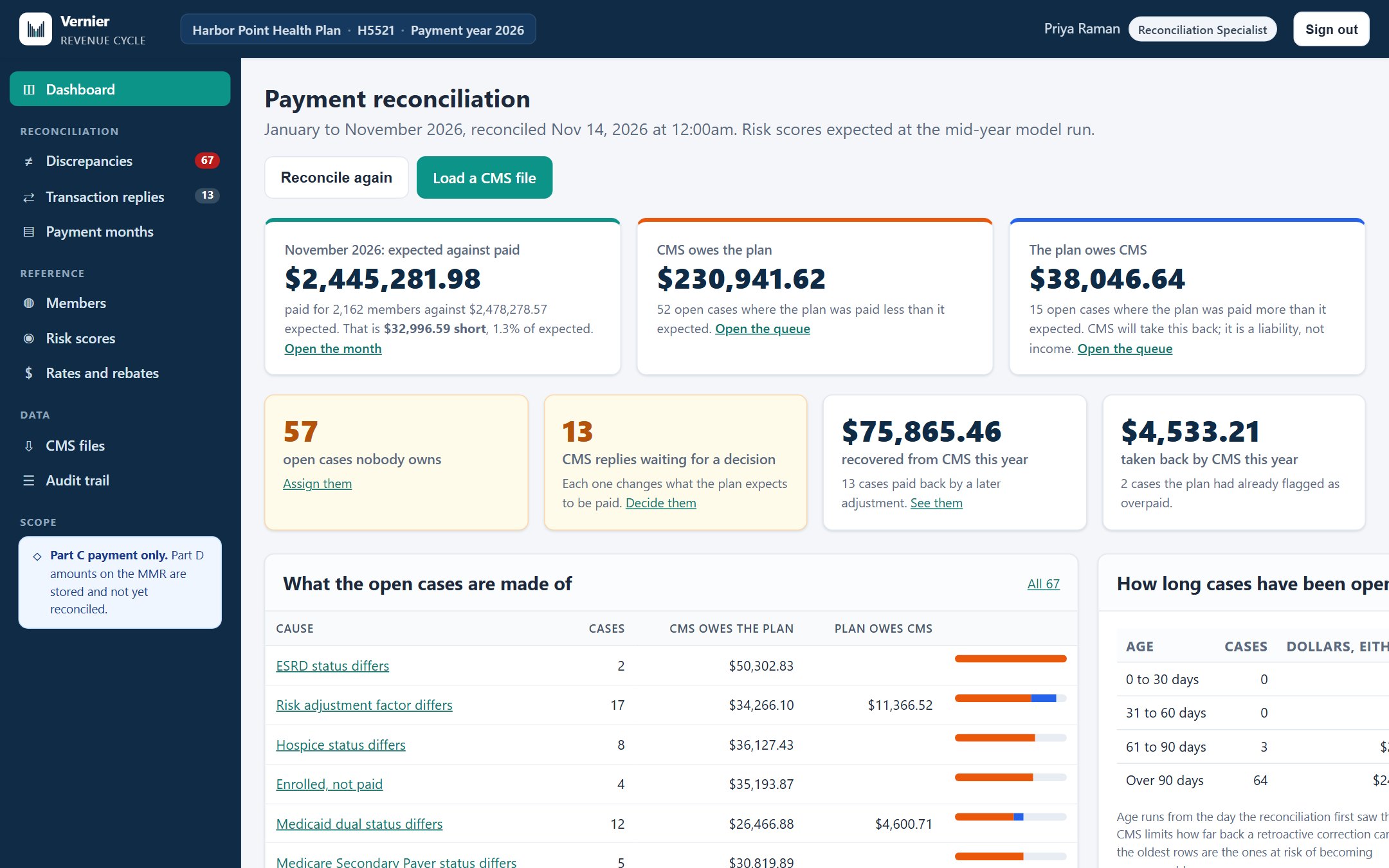
Three CMS files in, a worked queue out.
The plan already receives everything this needs: the Monthly Membership Report, the Transaction Reply Report and the Part C Model Output Report. Nothing is re-keyed and nothing is estimated.
The file says what it is
The fixed-width layouts from CMS's Plan Communications User Guide, read byte for byte. A file loaded twice, a second MMR for a month already loaded, or a file for another contract is refused whole. A bad row is refused with its line number and the rest loads.
What CMS should have paid
The plan's rate times the member's risk factor, plus the rebates, for Part A and Part B, with the hospice, ESRD and Medicare Secondary Payer rules applied. Every expected dollar traces to a rate and a factor on screen.
Twelve causes, and the split adds up
Enrollment, hospice, ESRD, Medicaid status, county, benefit package, rate, risk score and the rest. Where two facts disagree, each gets its share, and the shares always sum to the variance exactly.
A month is not settled when it is paid.
CMS pays a month prospectively and corrects it later with adjustment rows in subsequent files, sometimes more than once. What was paid for March is the March payment plus every adjustment since that covers March. Vernier keeps that running total for every member and month.
- One case per member and cause, however many months it spans.
- A case closes itself when a later adjustment pays it back, and records which file and reason code did it.
- What CMS owes the plan and what the plan owes CMS are reported separately and never netted.
- A CMS reply that changes what the plan expects waits for a person to apply or dispute it. Nothing is applied automatically.
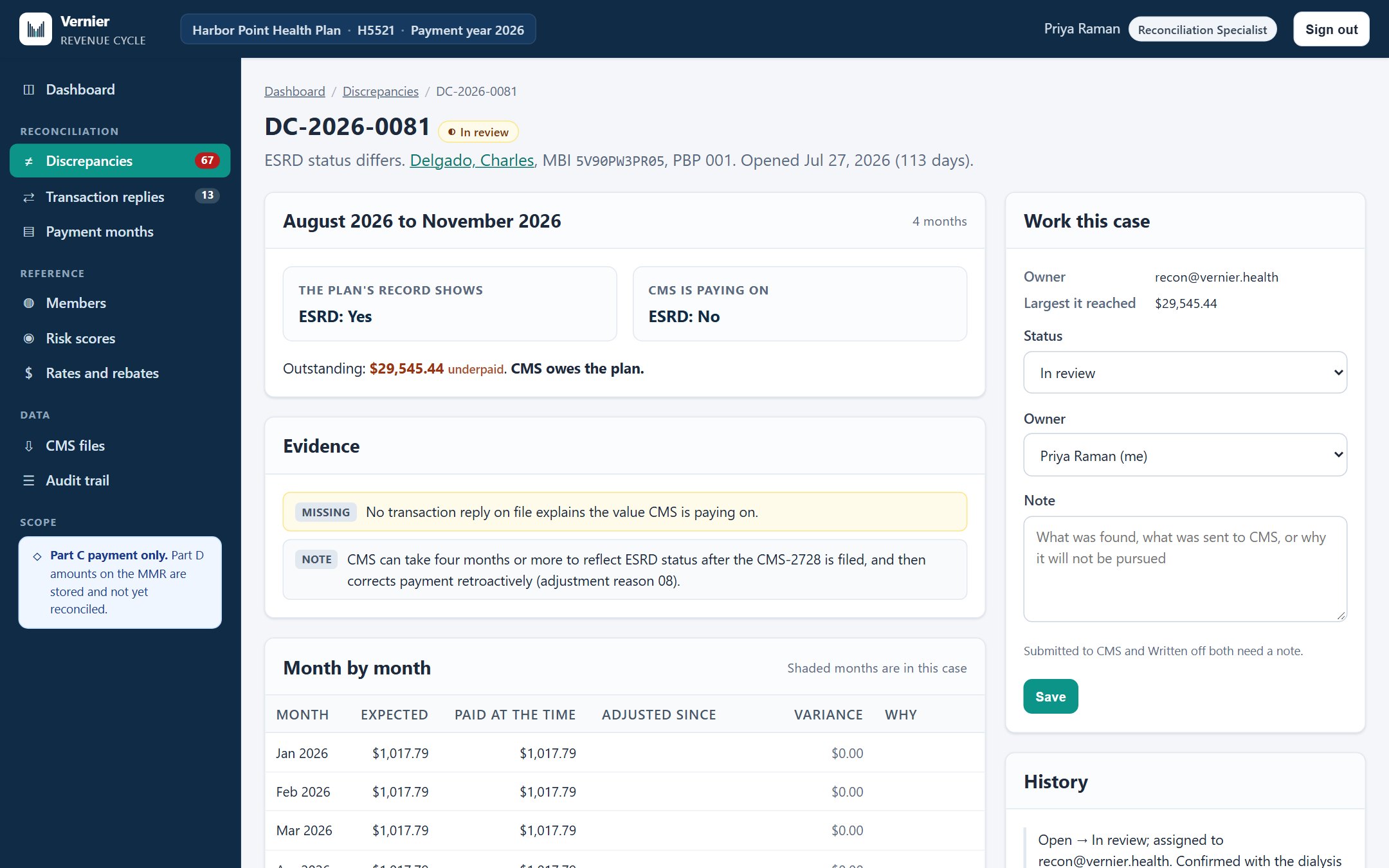
Eight views, one reconciliation.
Checked against a real CMS file, and honest about what is not.
Read a real MMR cleanly
A real Monthly Membership Report parsed without a rejected row. On every prospective row, the rate times the risk factor reproduced CMS's own amount to the cent, and every multi-month adjustment behaved as the reconciliation assumes.
What is not reconciled is stated
Adjustments reaching back to earlier payment years are counted and shown on the file's page, not silently left out. A month with no MMR loaded is flagged on the dashboard before anyone works the queue.
Not yet
- Part D reconciliation. The amounts are stored.
- The Plan Payment Report, and the tie-out to the bank deposit.
- Premium billing and payment posting.
- Rebate, hospice and MSP arithmetic confirmed against a Medicare Advantage plan's own file.