Read the record. Show the evidence. The nurse decides.
A care plan is only useful if a nurse can trust where it came from. Vernier reads a member's diagnoses, medical claims and pharmacy fills, builds a plan for that person, and shows the line of the record behind every statement. Nothing is final until a care manager accepts it.
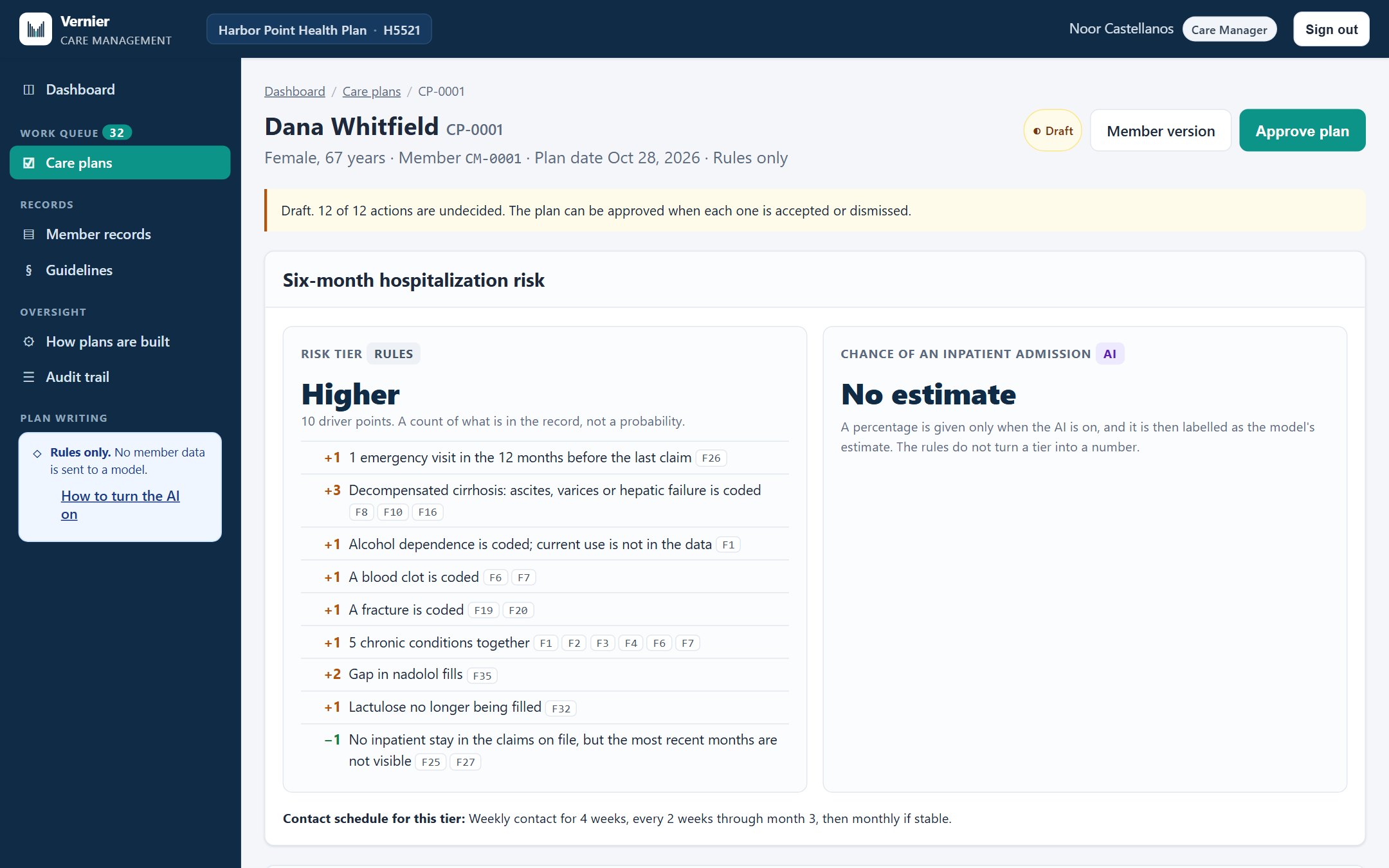
One member's record in, a plan a nurse can check.
The plan is built from what the health plan already holds for the member: the diagnosis codes, the medical claims and the pharmacy fills. Written rules build every plan, and the same record always produces the same plan.
A line it cannot read is not guessed
Each diagnosis, claim and fill is read as written. A line with no readable date or code is left out and listed with its line number, so the nurse knows what the plan did not see.
What the fills and claims show
Each diagnosis counted across the claims, inpatient and emergency dates, a gap of more than 60 days with no supply on hand, a medicine filled once, a medicine no longer filled, and the months the claims cannot see.
For that member, not for the diagnosis
Disease states from coded diagnoses, a six-month hospitalization risk tier, actions with due dates, the questions only the member or provider can answer, and a contact schedule.
Every statement points to the record.
Each fact taken from the record is numbered. A disease state, a risk driver, an action and a question each carry the numbers of the facts they rest on, and the record as loaded can be opened beside the plan.
- A disease state comes from a coded diagnosis. A medicine without a matching diagnosis raises a question for the nurse, never a diagnosis.
- The risk tier is shown with its arithmetic: every driver and its points, so a nurse can see why and disagree.
- No action starts, stops or changes a medicine. Those are worded as something to raise with the treating provider.
- An action is a proposal until a care manager accepts or dismisses it, and a dismissal needs a reason. A plan cannot be approved with an action undecided.
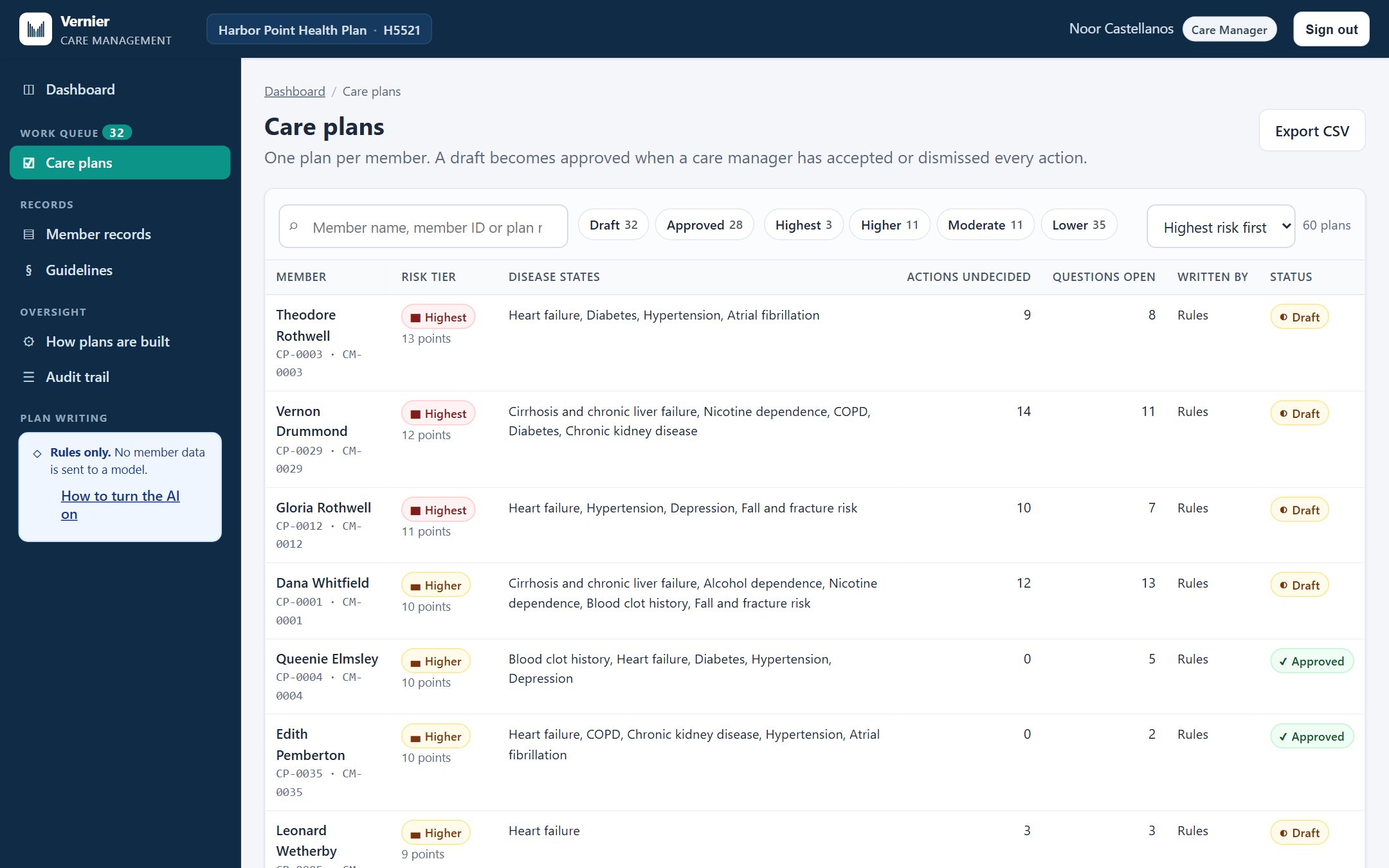
Nine views, one plan per member.
A plan the member can read.
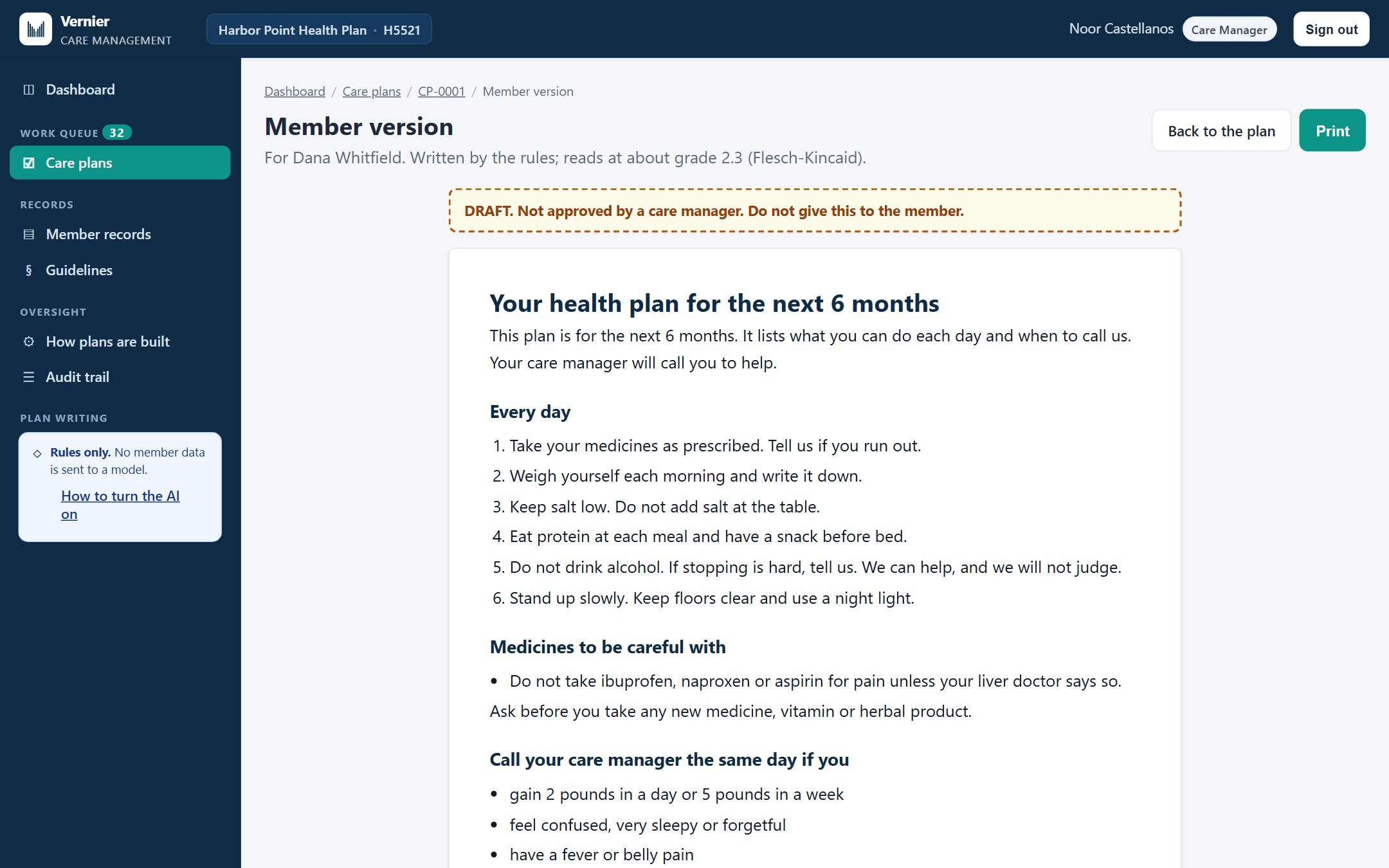
Each plan has a member version written in short, plain sentences: what to do every day, which medicines to be careful with, when to call the care manager the same day and when to call 911. The reading grade level is measured, not asserted, and it is shown at the top of the page.
The sheet is printed or read with the member. It is not posted to the member portal.
Optional, checked, and honest about its limits.
It can propose, it cannot decide
With the AI on, a language model may add actions, questions and an estimated chance of admission as a percentage range, each labelled as AI. Each addition must point to facts in the member's record. One that cites a fact that is not there is discarded, and the discard is logged.
Off by default
With the AI off the application works in full, the plan is written by the rules alone, and no member data leaves the plan's server. A citation to a guideline that is not in the client's library is removed.
Not yet
- The risk tier is a transparent count of drivers. It is not a validated predictive model.
- The AI path has not yet run on live member data.
- Claims feeds, lab results and clinical notes. Today it reads one text layout.
- Plans shown in the member and provider portals.
- Clinical review of the condition library with a client's medical director.